
HYDROGEN ENERGY TECHNOLOGY: THE FUEL OF THE FUTURE
POWERING A SUSTAINABLE AND DECARBONIZED WORLD
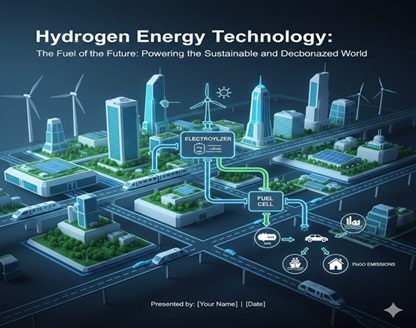
INTRODUCTION TO HYDROGEN
WHAT IS HYDROGEN AND WHY IS IT IMPORTANT?
Key Points:
o Abundance: Hydrogen (H_2) is the most abundant element in the universe.
o Energy Carrier, Not a Source: It must be produced using energy (like electricity, heat, or solar).
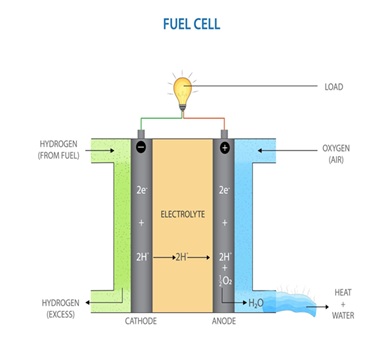
o Zero-Emission Fuel: The only by-product when used in a fuel cell is pure water (H_2O).
o High Energy Density: It has a very high energy-to-mass ratio, making it excellent for heavy-duty transport and long-range applications.
o Visual: A simple graphic showing 2H_2 + O_2 \ right arrow 2H_2O + \text{Energy}
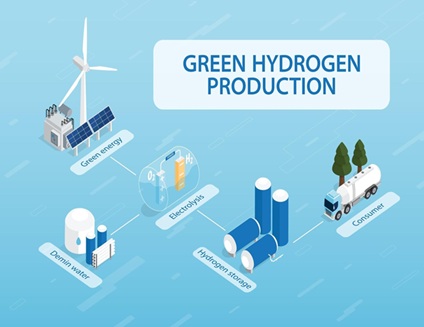
THE “COLOR” SPECTRUM OF HYDROGEN PRODUCTION
HOW IS HYDROGEN PRODUCED? THE COLOR CODE
Key Concept: The environmental impact of H_2 depends entirely on its production method.
Table/List:
o Produced via electrolysis powered by renewable energy (solar, wind). Zero-emission. This is the ultimate goal.
o Produced from natural gas (Methane: CH_4) via Steam Methane Reforming (SMR), but the resulting {CO2} is captured and stored (Carbon Capture and Storage – CCS). Low-emission.
o Grey Hydrogen: Produced from natural gas (SMR) with {CO2} released into the atmosphere. The most common method today. High-emission.
o Visuals Right
APPLICATIONS OF HYDROGEN ENERGY
WHERE CAN HYDROGEN BE USED?
o Key Areas (Use Icons/Small Images):
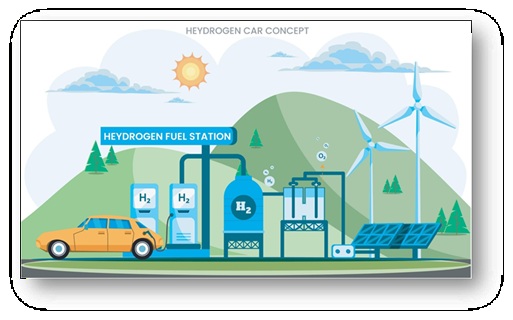
o Mobility (Transportation): Fuel Cell Electric Vehicles (FCEVs), heavy-duty trucks, trains, ships, and aircraft. (Targeting sectors hard to decarbonize with batteries).
o Industry: As a clean feedstock for processes like steel and cement production, replacing fossil fuels in high-temperature heating.
o Power Generation/Grid Storage: Blending hydrogen into existing natural gas pipelines (up to a certain limit) and using it in gas turbines, or storing excess renewable energy for later use.
o Buildings: Fuel cell combined heat and power (CHP) units for highly efficient home or commercial power/heat. Visual: A collage of different applications (FCEV car, steel factory, power plant)
ADVANTAGES OF HYDROGEN
WHY HYDROGEN IS A KEY CLIMATE SOLUTION
o Zero Emissions at Use: Only water is produced.
o Energy Security: Can be produced domestically using various resources.
o Versatility: Can be stored as a gas (compressed) or a liquid (cryogenic) for flexible distribution.
o Enables Renewables: Acts as a long-duration energy storage solution, stabilizing the electrical grid by storing intermittent solar and wind power.
o Visual: A graphic illustrating H_2 bridging the gap between intermittent renewables and consistent energy demand.
CHALLENGES AND THE PATH FORWARD
OBSTACLES AND FUTURE OUTLOOK
Key Challenges:
o Cost: Green H_2 is currently more expensive than fossil fuel-based grey H_2.
o Infrastructure: Lack of widespread refueling stations and large-scale pipeline transport.
o Storage & Distribution: High-pressure compression or cryogenic liquefaction is energy-intensive.
o Safety Perception: Public concerns about flammability (address with facts: H_2 is lighter than air and dissipates quickly).
0 Path Forward:
o Technological advancements in electrolyzer efficiency.
o Government policies (tax credits, R&D funding).
o Development of Hydrogen Hubs (regional production and distribution networks). Visual: A roadmap graphic showing the expected cost reduction and infrastructure build-out over the next decade.
CONCLUSION AND CALL TO ACTION
SUMMARY: THE HYDROGEN ECONOMY IS ARRIVING
o Key Takeaway: Hydrogen is an indispensable energy carrier for achieving global net-zero emissions, particularly in heavy industry and long-haul transport.
o Closing Statement: Investing in Green Hydrogen is investing in a truly sustainable, resilient, and decarbonized energy system.
o Call to Action: What questions do you have about the Hydrogen Economy?
o Visual: A powerful image summarizing the presentation’s core message.
Would you like me to elaborate on a specific slide or provide more detailed technical information on one of the concepts, like the different types of electrolyzers?
Hydrogen energy technology centers on hydrogen (H_2) as a clean, versatile energy carrier—not a primary source—that can be produced, stored, and converted into electricity or heat with zero carbon emissions at the point of use.
💡 WHY HYDROGEN IS THE FUEL OF THE FUTURE
SUMMARY: THE HYDROGEN ECONOMY IS ARRIVING
o Zero-Emission Use: When hydrogen is used in a fuel cell , it reacts with oxygen to produce only water (H2O) and electricity, eliminating greenhouse gases and air pollutants.
o High Energy Density: It has the highest energy content by weight of any common fuel (three times that of gasoline), making it ideal for heavy-duty transport and long-range applications.
o Storage and Versatility: It can store massive amounts of energy over long periods (acting as a buffer for intermittent renewable sources like solar and wind) and can be easily converted into electricity, synthetic fuels (like ammonia or methanol), or heat.
🏭 PRODUCTION: THE HYDROGEN “COLOR CODE”
Hydrogen production methods determine its environmental impact, giving rise to the “color” classifications:
| Hydrogen Type | Production Method | Emissions Profile
Electrolysis of water using Renewable Electricity (solar, wind). Zero-emission. The ultimate goal. Steam Methane Reforming (SMR) of natural gas, with the resulting CO2 captured and permanently stored (Carbon Capture and Storage – CCS). Low-emission.
Steam Methane Reforming (SMR) of natural gas, with {CO2} released into the atmosphere. | High-emission. (Most common today).
🌍KEY USES OF HYDROGEN ENERGY
Hydrogen’s versatility allows it to address emissions in sectors that are difficult to decarbonize through electrification alone:
1. Transportation (Mobility)
o Fuel Cell Electric Vehicles (FCEVs): Cars, buses, and trucks powered by hydrogen fuel cells, offering long ranges and fast refueling times similar to gasoline vehicles.
o Heavy Industry Transport: Decarbonizing shipping, rail, and aviation, where batteries are too heavy or limited in range.
2. Industrial Processes
o Steel Production: Replacing coal with hydrogen as the reducing agent to produce “green steel,” a key step toward industrial net-zero goals.
o Chemical Feedstock: Used in the production of high-volume chemicals like ammonia (for fertilizer) and methanol.
o High-Temperature Heat: Using hydrogen combustion in processes like cement and glass manufacturing.
3. Power Generation and Storage
o Grid Balancing: Storing surplus renewable energy (Power-to-Gas) and converting it back into electricity when needed using fuel cells or modified gas turbines.
o Backup Power: Stationary fuel cells providing clean, reliable backup power for hospitals, data centers, and remote locations.