
FSRU & FLNG: The Modern Floating Giants
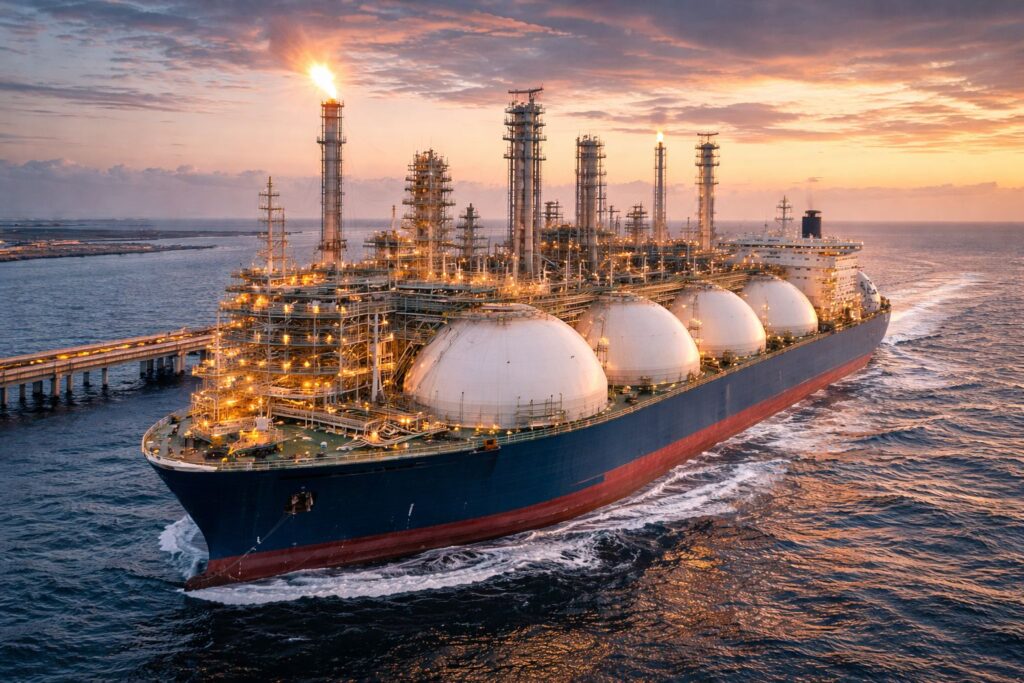
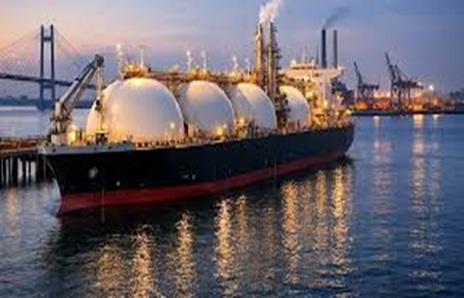
An FSRU (Floating Storage Regasification Unit) is a specialized maritime vessel that stores liquefied natural gas (LNG) and converts it back into a gaseous state onboard. Acting as a mobile, floating import terminal, it regasifies LNG and delivers it directly to shore-based pipeline networks without the need for large, permanent land-based facilities.
• How Floating LNG Technology is Reshaping Global Energy.
• Storage, Regasification & Liquefaction at Sea.
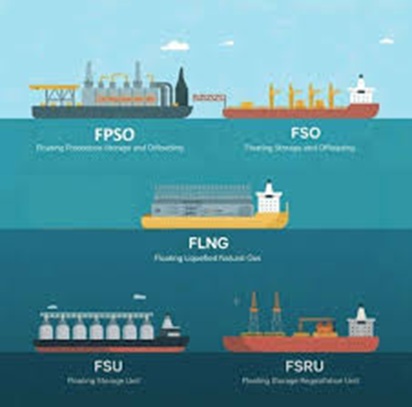
• FSRU – Floating Storage and Regasification Unit.
• FLNG – Floating Liquefied Natural Gas
Key Functions
Storage: FSRU’s hold massive volumes of super-cooled LNG at about (-160 oC) in heavily insulated, specialized cargo tanks.
Regasification: The vessel uses onboard equipment (often heat exchangers using glycol water) to safely heat and pressurize the LNG, transforming it back into a usable gas.
Transfer: The pressurized gas is exported from the ship through high-pressure flexible hoses or unloading arms into coastal or national pipeline grids.
Why FSRU’s are Used
Faster Deployment: They can be operational in a fraction of the time it takes to construct permanent land-based terminals.
Cost-Effective: They offer a significantly cheaper alternative to onshore receiving infrastructure.
Flexibility: When not actively regasifying, FSRU’s can be detached or used as standard LNG carriers, making them highly adaptable to seasonal or emergency energy demands.
FSRU – Floating Storage and Regasification Unit.
It is a specialized type of marine vessel or offshore facility used in the Liquefied Natural Gas (LNG) industry.
Here is a quick breakdown of how it works:
• Storage: It receives and stores LNG at cryogenic temperatures (-160oC) delivered by standard carrier ships.
• Regasification: On-board equipment heats the LNG, turning it back into its natural gaseous state.
• Distribution: The natural gas is then pressurized and sent ashore via pipelines for domestic or industrial use. FSRUs are highly valued in the energy sector because they act as faster, more flexible, and more cost-effective alternatives to traditional onshore LNG terminals.
The LNG Challenge
• Problem: Natural gas is clean but hard to transport. Pipelines are expensive & geopolitically limited.
• Solution: Cool gas to -162°C to make LNG → 600x smaller volume.
• New bottleneck: Traditional onshore terminals take 5+ years and $1B+ to built.
• Answer: Take the plant to the gas, or bring the terminal to the market.
Meet the Floating Duo, FSRU – FLNG
• Floating Storage Regasification Unit – Floating Liquefied Natural Gas
• “Import terminal on a ship“ & “LNG factory on a ship”
• Receives LNG, stores it, turns it back to gas Produces, treats, liquefies, stores & loads LNG offshore
• Located near demand markets Located above offshore gas fields
How an FSRU Works – The Import Side
Step-by-step flow:
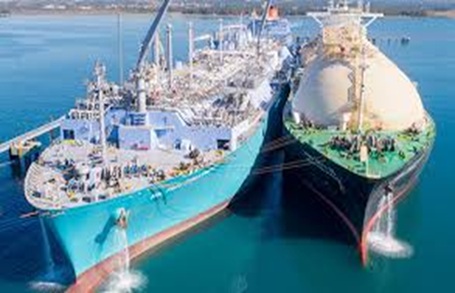
1. Berthing & Transfer: LNG carrier moors alongside FSRU. LNG at -162°C transferred via cryogenic hoses or unloading arms.
2. Storage: LNG stored in membrane or spherical Moss tanks. Typical capacity ∼170,000 m³.
3. Regasification: LNG pumped to high pressure, then heated from -162°C to +10°C.
– Open loop: Seawater warms LNG
– Closed loop: Freshwater/glycol heated by ship boilers
4. Send-out: High-pressure gas sent through pipeline to shore for power plants, industry, homes.
• Key equipment: Tanks, regasification trains, HP manifold, gas metering system.
How an FLNG Works – The Export Side
Step-by-step flow:
1. Production: Anchored over offshore gas field. Receives raw gas from subsea wells.
2. Treatment: Removes water, CO₂, H₂S, mercury to prevent freezing/corrosion.
3. Liquefaction: Cools gas to -162°C using refrigeration cycles.
4. Storage: LNG stored in hull-integrated cryogenic tanks.
5. Offloading: LNG transferred to conventional LNG carrier for export.
• First FLNG: Petronas PFLNG Satu, 2017.
• Largest FLNG: Shell Prelude, 2019
Why Go Floating?
Key Advantages
1. Speed: FSRU can be deployed in <2 years vs 5+ for onshore.
2. New-build: Approx. ∼3 years.
3. Cost: Conversion $100-150M, new-build ∼$300M. Much cheaper than onshore.
4. Flexibility: Can relocate to new markets as demand shifts. Acts as temporary solution.
5. Access: FLNG unlocks remote/stranded gas fields too far for pipelines.
6. Footprint: No large onshore land needed. Lower environmental impact.
FSRU vs On-shore Terminal
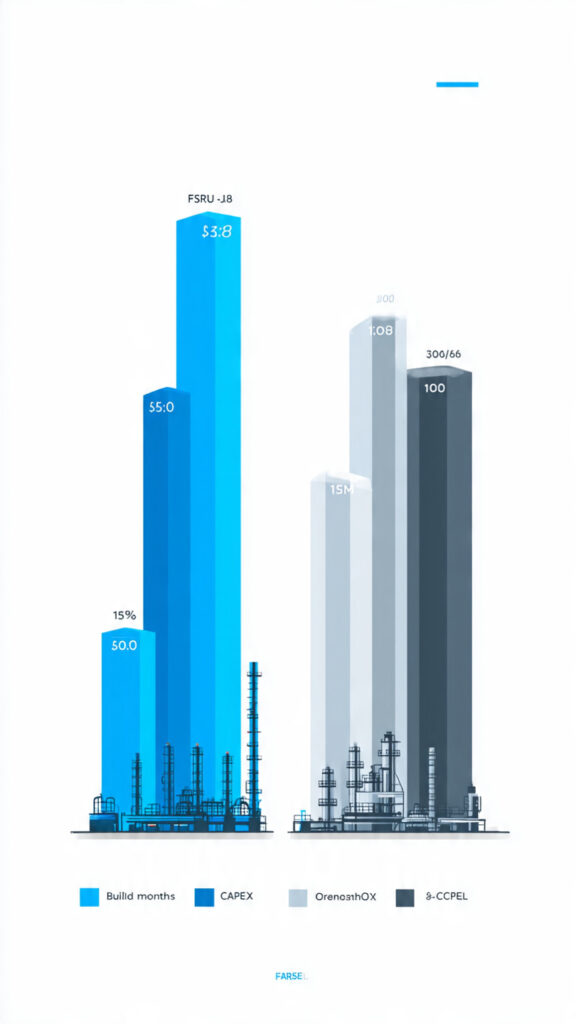
1. Factor – FSRU – Onshore Terminal
2. Build time – 18 – 36 months to 5 – 7 years
3. CAPEX – $100M – $300M – $1B+
4. Mobility – Relocatable Fixed
5. Infrastructure – Minimal port/pipeline Extensive berthing, tanks, piping.
6. Best for – Fast, seasonal, smaller markets Large, long-term base-load demand.
Technical Challenges
1. Rollover: LNG stratification in tanks can cause sudden boil-off & pressure spikes. Managed by monitoring saturated vapor pressure.
2. BOG Management: Boil-off gas must be re-liquefied or used as fuel to prevent tank over-pressure.
3. Mooring: FSRUs need robust systems like Tower Yoke Mooring for shallow water.
4. Weather: Sea-keeping and off-loading in rough seas for FLNG/FSRU.
5. Cost/Complexity: FLNG still has high costs & technical hurdles – only a handful operating.
Global Fleet & Growth
1. FSRU’s: 48 vessels end of 2021 vs 588 conventional LNG tankers. 19 more under construction.
2. Key players: Excelerate Energy owns 10 FSRUs. South Korea builds most.
3. Notable Units: Turkey’s Ertuğrul Gazi – 170,000 m³ storage, 28 million Sm³/day regas capacity.
4. Trend: Jordan, Egypt chose FSRU for first LNG imports in 2015. Used in 10+ countries since 2005.
Future Outlook
1. Energy Security: FSRUs enable Europe/countries to diversify gas supply fast post-2022.
2. Energy Transition: Small-medium FSRUs bring LNG to island nations, displacing diesel.
3. De-carbonization: LNG cold energy can be used for power generation, air separation.
4. FLNG Growth: More interest to monetize remote offshore gas.
Key Takeaways
1. FSRU – Floating import terminal: Store + regasify LNG at sea.
2. FLNG – Floating export plant: Liquefy gas at the offshore field.
3. Game changers: Cut cost/time 50-70% vs onshore, add huge flexibility.
4. Not Perfect: Rollover, BOG, and weather are real engineering challenges.
5. Here to Stay: Rapidly expanding sector of LNG business.
Engineering Hurdles
1. Visual: Icons for each challenge.
2. Rollover: LNG layers mix → sudden boil-off. Needs monitoring.
3. BOG: Boil-off gas must be used as fuel or re-liquefied.
4. Mooring: Needs tower yoke systems for shallow water.
5. Weather: Offloading in rough seas is complex.
The Future is Floating
World map with FSRU/FLNG dots in Brazil, Turkey, Lithuania, Australia, Malaysia
Trends:
1. Energy Security: EU deployed FSRUs rapidly after 2022 for non-Russian gas.
2. New Markets: Pakistan, Jordan, Egypt started LNG imports via FSRU in 2015.
3. Energy Transition: Replaces diesel/coal in island nations.FLNG Growth: Monetizing remote offshore gas that was “stranded”.